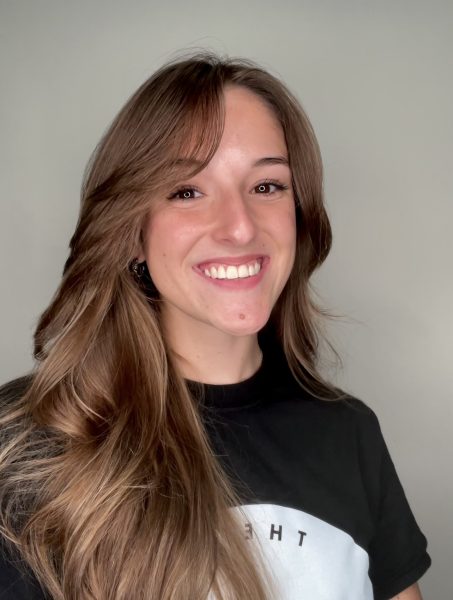


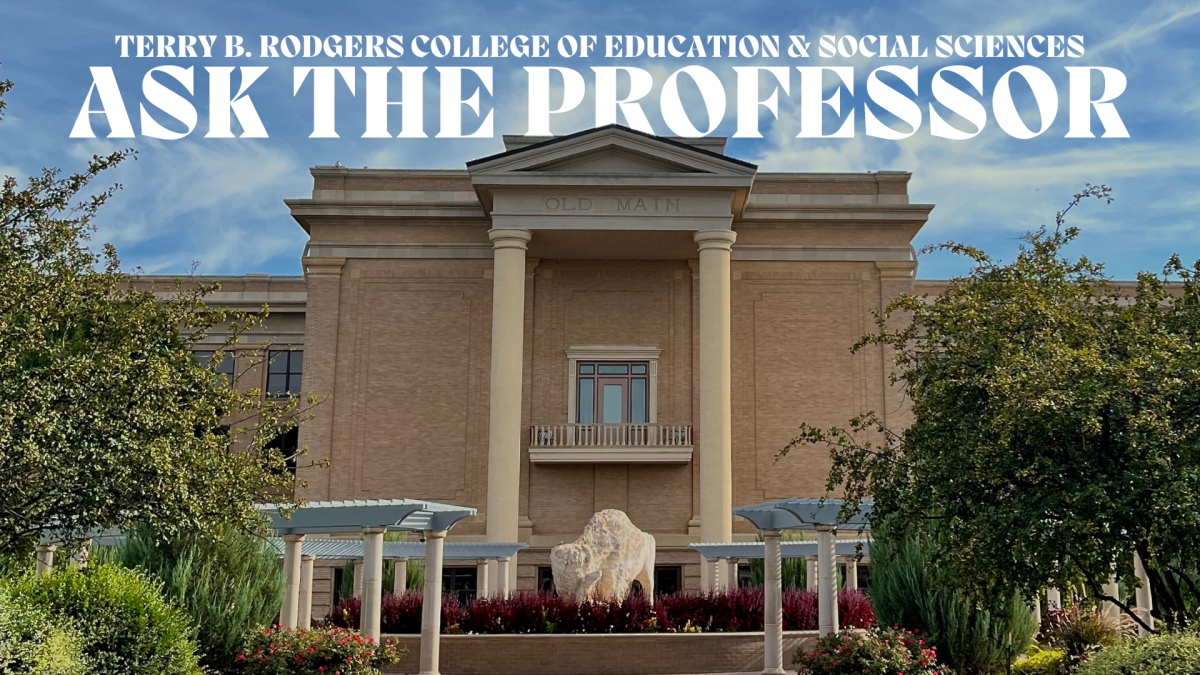
Dr. Brandon L. Bang is the director of the criminal justice program, and an associate professor of criminal justice for the Terry B. Rogers College of Education and Social Sciences at West Texas A&M University (WT).
Bang is also the faculty advisor to the Criminal Justice Association and was the last president of the WT Faculty Senate. He utilizes his knowledge and expertise to give back to students of the program and beyond. Bang was born and raised in Payson, Utah. He originally pursued a career in psychology, but later decided it was not quite a fit for him.
“Once I got my degree in psychology, I decided that although I love psychology, I just didn’t want to be a psychologist anymore.” Bang said. “I graduated, I applied to work for the highway patrol, and then I also applied to get my master’s degree in criminal justice at Washington State University. I decided to get my master’s degree, so I moved to Pullman, Washington. There, they told me that they felt like I was really good and that I should pursue a PhD, which was something that had never really crossed my mind before.”
After completing the master’s program, fate found a way to bring Bang to WT.
“I wish I had a fantastic story, but they [WT] were hiring when I needed a job,” Bang said. “Yeah, I was out on the job market. I was working on finishing up my PhD at Washington State. I ran out of funding, but my dissertation wasn’t done yet. So I applied to work at Elmira College, which is a very small liberal arts college in Elmira, New York. It’s actually kind of famous in criminal justice. There’s a famous prison there, a reformatory. And then I also applied here at WT. Fortunately, I was hired by both. I felt like moving from Washington State to New York was a big move. So I came here to WT.”
But Bang found a place to call home at WT.
“I love WT, I especially love the campus at WT,” Bang said. “I think Old Main is just such a beautiful building, and they keep it up so well. And sometimes I forget how lucky I am to work out of this building and have my office where it is.”
Bang teaches a variety of courses, but they vary semester to semester.
“I teach a lot of courses, I believe I’ve almost taught all the courses on our catalog, but I can tell you which ones I generally teach,” Bang said. “So my main areas that I teach here are courts, law, policing and ethics type stuff. I’ve taught juvenile delinquency. But I’ve taught capital punishment, I’ve taught research methods, I used to teach our criminal courts course. Right now, I primarily teach criminal procedure and criminal law, I also teach our ethics course, which I love. Teaching that class, philosophy, is sort of like my hobby.”
As an advisor, Bang has opportunities to know students in the program and offer valuable insights.
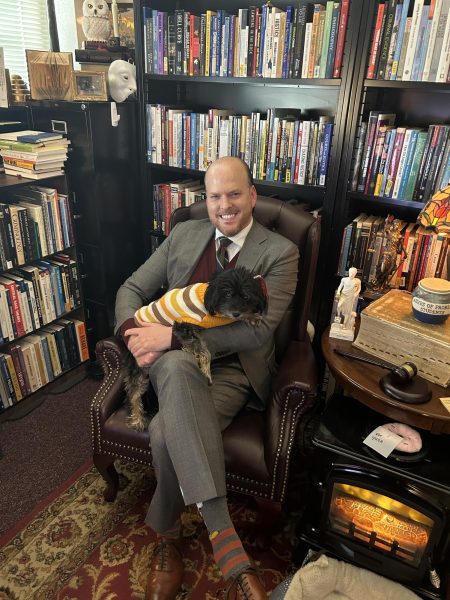
“I am the current advisor for the Criminal Justice Association, which we’re very pleased with,” Bang said. “As of late, it’s really come quite a long way within the last few years. And I was the last faculty senate president here at WT as well. If you’ve been following what’s been going on with that, the Faculty Senate in Texas were, in a sense, kind of dissolved. And so I was the president when we were dissolved. We’ve formed a faculty advisory council now, and so I am on that, and I’ve been working on that transition kind of between the two organizations.”
Bang described his teaching style as student-oriented.
“I think my teaching style is that, rather than teaching a class, I teach a student,” Bang said. “I try to do my best to make every student feel as if I’m teaching just them in class, and so I try to be very interactive and engaged with my students. I try to do a lot of discussion, a lot of people would use the term like the Socratic method, which wouldn’t be wrong, but at times it’s more as if I’m cross examining a student in the class, and so be engaged and get the students engaged, and try to really draw out of them possible contradictions that they may have in their thinking, and whether I change their mind or not isn’t important to me at all, but I do want them to question what they think and how they believe things.”
For students considering joining the program, Bang had this to say.
“Students coming into the program should have the attitude that they want to learn,” Bang said. “We’re here to put out very good social scientists, people who understand the social science behind criminal justice, while also getting a flavor of that practitioner component as well. A lot of our students do go into policing, but we do have a lot of students who go to law school. We have a lot of students who go to graduate school, and we’ve even put some students into PhD programs and so, you know, we’re not just a cop shop here.”